 Faith Masita
In Nakuru County, a line of women in bright headscarves move in rhythm. Their feet press into sawdust, pushing it forward, pulling it back, folding and spreading it thin under the scorching sun. The progress is deliberate. Repetitive. Almost meditative.
They are not just drying waste.They are reshaping the future of fuel.
From Waste to Worth
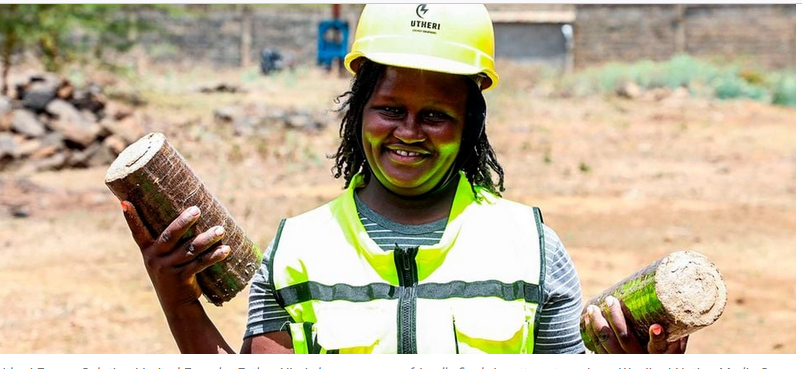
What lies beneath their feet was once discarded timber residue swept aside in sawmills, left to rot, or burned in smoky heaps. Today, it is the raw material for eco-friendly briquettes, a cleaner alternative to charcoal and firewood.
In a country where millions of households still rely on biomass for cooking, the pressure on forests has been relentless. Trees fall to feed kitchen fires. Charcoal kilns smoulder in shrinking woodlands. The environmental cost has long been accepted as unavoidable.
But here in Maai Mahiu, waste is being reimagined as energy.
The women spread the sawdust so it dries evenly. Once moisture levels drop, it will be mixed, compressed and moulded into dense, uniform briquettes. The result is a fuel that burns longer, produces less smoke and reduces the demand for freshly cut wood.It is climate action at ground level powered not by policy speeches, but by calloused hands.
Fueling More Than Fires
The briquettes are gaining traction among households, schools and small businesses looking to cut fuel costs while reducing smoke exposure. For many families, they offer a practical solution: affordable, efficient and easier on the lungs.
Each sack sold represents fewer trees felled. Each briquette signals a shift from extractive to regenerative thinking. And for the women on the drying beds, each day’s labour translates into income, dignity and financial independence.
In communities where employment opportunities can be scarce, briquette production has become both a climate solution and a livelihood lifeline. What began as an environmental intervention is quietly transforming into an economic one.
climate
Kenya’s climate conversation often focuses on droughts, floods and shrinking forests. Yet the story in Maai Mahiu is about agency about communities responding with ingenuity rather than waiting for rescue.
The process is simple but powerful: collect waste, dry it, compress it, sell it. Reduce smoke. Protect trees. Create jobs.
Under the scorching Nakuru sun, the women continue their steady choreography. Sawdust rises in soft clouds around their ankles. Laughter cuts through the heat. A rhythm holds.
They are not scientists in white coats or executives in glass towers.They are mothers, farmers, entrepreneurs.And with every turn of the sawdust, they are proving that climate solutions do not have to be grand to be transformative. Sometimes, they begin with what we throw away and the determination to do better with it.
They are not just drying waste.They are reshaping the future of fuel.
From Waste to Worth
What lies beneath their feet was once discarded timber residue swept aside in sawmills, left to rot, or burned in smoky heaps. Today, it is the raw material for eco-friendly briquettes, a cleaner alternative to charcoal and firewood.
In a country where millions of households still rely on biomass for cooking, the pressure on forests has been relentless. Trees fall to feed kitchen fires. Charcoal kilns smoulder in shrinking woodlands. The environmental cost has long been accepted as unavoidable.
But here in Maai Mahiu, waste is being reimagined as energy.
The women spread the sawdust so it dries evenly. Once moisture levels drop, it will be mixed, compressed and moulded into dense, uniform briquettes. The result is a fuel that burns longer, produces less smoke and reduces the demand for freshly cut wood.It is climate action at ground level powered not by policy speeches, but by calloused hands.
Fueling More Than Fires
The briquettes are gaining traction among households, schools and small businesses looking to cut fuel costs while reducing smoke exposure. For many families, they offer a practical solution: affordable, efficient and easier on the lungs.
Each sack sold represents fewer trees felled. Each briquette signals a shift from extractive to regenerative thinking. And for the women on the drying beds, each day’s labour translates into income, dignity and financial independence.
In communities where employment opportunities can be scarce, briquette production has become both a climate solution and a livelihood lifeline. What began as an environmental intervention is quietly transforming into an economic one.
climate
Kenya’s climate conversation often focuses on droughts, floods and shrinking forests. Yet the story in Maai Mahiu is about agency about communities responding with ingenuity rather than waiting for rescue.
The process is simple but powerful: collect waste, dry it, compress it, sell it. Reduce smoke. Protect trees. Create jobs.
Under the scorching Nakuru sun, the women continue their steady choreography. Sawdust rises in soft clouds around their ankles. Laughter cuts through the heat. A rhythm holds.
They are not scientists in white coats or executives in glass towers.They are mothers, farmers, entrepreneurs.And with every turn of the sawdust, they are proving that climate solutions do not have to be grand to be transformative. Sometimes, they begin with what we throw away and the determination to do better with it.