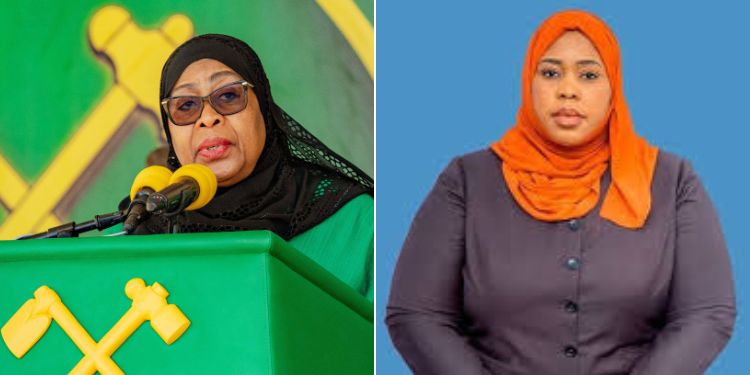
The expansive lawns of Chamwino State House in Dodoma, where the acacia trees stand like timeless guardians against the vast Central Plateau's golden horizon, were bathed in the soft glow of November sunlight on the morning of November 18, 2025. A light breeze rustled the Tanzanian flags lining the ceremonial avenue, carrying the faint scent of rain from distant hills as a small but significant gathering assembled for a swearing-in ceremony that blended the solemnity of public service with the intimacy of familial legacy. At the center of the dais, under a canopy of the national colors—green, black, yellow, and blue—stood Wanu Hafidh Ameir, the 43-year-old lawyer and Member of Parliament for Mjini Magharibi in Zanzibar, her navy blue kitenge dress embroidered with subtle motifs of open books and rising suns symbolizing her new charge. Flanking her was her husband, Mohammed Mchengerwa, the 46-year-old MP for Rufiji and newly appointed Minister of Health, his crisp suit a testament to the shared journey that had elevated the couple to the heart of national governance. As President Samia Suluhu Hassan, her own attire a regal black ensemble with gold accents evoking Zanzibari heritage, administered the oath, Wanu raised her right hand and pledged fidelity to the republic, her voice steady yet infused with the quiet gravity of a milestone that had sparked both celebration and scrutiny across the archipelago and mainland.
The ceremony, a compact affair attended by 150 dignitaries including CCM elders, opposition MPs from ACT-Wazalendo, and family members flown in from Zanzibar, unfolded with the precision of Tanzanian protocol. Chief Justice Ibrahim Juma, his robes billowing slightly in the breeze, recited the constitutional pledge: "I, Wanu Hafidh Ameir, do swear that I will be faithful and bear true allegiance to the United Republic of Tanzania and the people of Tanzania, and that I will observe, uphold, and maintain the Constitution and all other laws of the land." Wanu, her expression a portrait of composed determination, repeated the words with clarity, her hand on a copy of the Constitution bound in leather embossed with the Uhuru Torch. Moments later, Mohammed followed suit, his oath as Health Minister echoing the couple's intertwined ascent in a reshuffle that had reshaped Suluhu's cabinet just weeks after her October 29 election victory. "You have been entrusted with the future of our children and the well-being of our people," Suluhu said in her brief address, her gaze lingering on her daughter with a mother's pride tempered by a leader's expectation. "Serve with integrity, innovation, and the unyielding commitment to education that will unlock Tanzania's potential. Your roles are not gifts; they are guardianships—for the nation, for the youth, for tomorrow."
Wanu Hafidh Ameir's appointment as Deputy Minister of Education, Science, and Technology—under the portfolio of full Minister Prof. Adolf Mkenda—marks a formal entry into the executive branch for the eldest child of Tanzania's first female president. Born on February 9, 1982, in Zanzibar to Samia and her husband Hafidh Ameir, Wanu grew up in the shadow of her mother's rising political star, from Zanzibar's House of Representatives in 2000 to the vice presidency in 2015 and the presidency in 2021. Educated at Mwanakwerekwe B Primary School and Kawanda Secondary, she pursued a certificate from Info-Serve in the U.S. and a diploma from the Centre for Foreign Relations, before earning a Bachelor of Laws from the Open University of Tanzania in 2018. Her parliamentary career, spanning since 2005 as MP for Mjini Magharibi, has focused on legal affairs and youth empowerment, serving on the Constitution and Legal Affairs Committee from 2015 to 2018 and as Regional Chairperson for the CCM Youth Wing from 2008 to 2012. "Motherhood and ministry have always been my twin callings—now, they converge in service to education," Wanu reflected in a post-oath interview at the state house gardens, her smile warm as she cradled a folder of ministry briefs. "I step into this role with the humility of a learner and the resolve of a leader, committed to bridging the gap between policy and the classroom."
The dual appointments—Wanu as deputy education minister and Mohammed as full Health Minister—have ignited a national conversation on nepotism versus meritocracy, a debate that has simmered since Suluhu's February 2021 ascension following John Pombe Magufuli's death. Mohammed, MP for Rufiji since 2020 and a CCM stalwart with a background in community development, brings a decade of experience in health advocacy to a portfolio strained by post-COVID recovery and malaria surges in the coastal regions. "Health is the heartbeat of the nation; as minister, I pledge to pulse with compassion and competence," he stated after his oath, his hand clasped with his wife's in a moment captured by state photographers and splashed across TBC headlines. The reshuffle, announced November 16, also elevated Ridhiwani Kikwete—son of former President Jakaya Kikwete—from deputy minister to full minister for Civil Service Management and Good Governance, prompting critics to decry a "family affair" in Dodoma. "Samia's cabinet is becoming a dynasty dossier—first daughter in education, son-in-law in health, Kikwete heir in governance," tweeted ACT-Wazalendo MP Ado Shaibu from Tunduru North on November 17, his post garnering 10,000 retweets amid a storm of memes juxtaposing the appointments with Nyerere's socialist ethos.
Suluhu, ever the diplomat whose consensus-building has stabilized Tanzania through economic liberalization and post-Magufuli reforms, defended the choices in her swearing-in address. "Talent knows no bloodlines—Wanu and Mohammed have earned their stripes through service, dedication, and a vision aligned with CCM's manifesto," she affirmed, her words a measured rebuttal to the opposition's barbs. "Education and health are the pillars of Vision 2050; my family serves as citizens first, appointees second." The president, who secured 98 percent in the October polls amid cries of uncompetitiveness from barred challengers like Tundu Lissu, has faced similar scrutiny since her 2021 elevation: appointing her sister-in-law to a parastatal board in 2022, her nephew to a youth fund in 2023. Yet, supporters point to Wanu's parliamentary record—bills on women's legal aid and digital literacy—and Mohammed's Rufiji projects, including a Sh500 million clinic network serving 100,000.
Wanu's swearing-in, the first for a presidential child in Tanzania's history, symbolizes a generational handoff in a nation where dynastic politics have been anathema since Nyerere's one-party era. "Mother taught me leadership is listening—first as MP, now as deputy, I'll listen to teachers in Dodoma and students in Zanzibar," Wanu said, her oath a bridge between her Zanzibari roots and mainland mandate. Married to Mohammed since 2012 in a low-key ceremony in Unguja, the couple's shared portfolio—education feeding health through literate communities—evokes synergy. "We serve side by side, not in shadow—health and education intertwined for a stronger Tanzania," Mohammed added, his role overseeing a Sh10 trillion health budget amid malaria's 5 million cases yearly.
Opposition Lissu, in Arusha: "Samia's family album in cabinet—CCM's corruption or coincidence?" ACT's Shaibu: "Dynasties devour democracy—repeal or reform." CCM's Mpango: "Merit manifests in family too—Wanu's law degree, Mohammed's development work qualify them." Suluhu's response: "Critics carp; citizens count—appointments advance agenda."
For Tanzanian families, the appointments resonate: Wanu's education push for 90 percent secondary enrollment by 2030, Mohammed's health reforms vaccinating 10 million children. A Rufiji mother: "Mohammed's clinics saved my baby—family in power? If they serve, we support." In Mjini Magharibi, a teacher: "Wanu knows our struggles—MP to minister, she'll fund labs."
As Dodoma's plateau winds stir, the swearing-in symbolizes shift: from family to future, a cabinet where legacy lifts the nation.
The reshuffle's 27 ministers: 29 deputies. Wanu's LLB 2018. Mohammed's Rufiji clinics Sh500 million. Lissu's tweet 10,000 RTs. Shaibu's "dynasties" 5,000 likes. Mpango's merit: CCM rally. Rufiji mother's baby: vaccinated. Mjini teacher's labs: funded. In Tanzania's timeless tapestry, the oaths open opportunity—a deputy and minister's mandate where family forges forward, and service sustains the state.